

Cleaning up the Canning
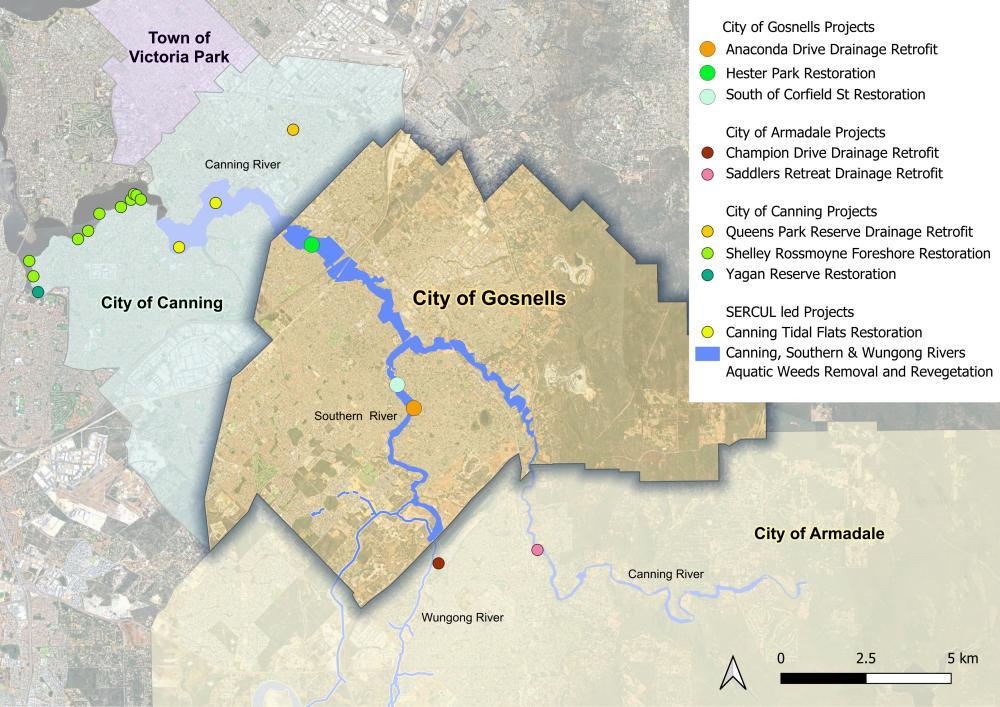
The City of Gosnells is leading several key restoration projects as part of the broader Cleaning up the Canning initiative, funded by the Australian Government’s Urban Rivers and Catchments Program and supported by local partners. Through this program, the City has secured $1,135,000 to deliver ecological restoration works across three sites along the Canning and Southern Rivers, with projects running through to May 2028. This collaborative effort will help to protect waterways, enhance habitat for wildlife, and improve green spaces.
This investment will allow the City of Gosnells to deliver restoration projects to improve the condition and connectivity of riparian areas, stream banks and aquatic habitats by undertaking targeted weed control and revegetation, and redesigning and retrofitting existing drainage systems.
The three sites:
- Biodiversity, habitat values and bank stabilisation will be improved at Hester Park through revegetation and weed control, increasing connectivity with remnant vegetation in the Canning River Regional Park. Marri; a primary food source for Black Cockatoos, and Flooded gum (Moitich); a secondary source, will be planted as part of the project, alongside Melaleuca trees and a diverse understory, benefitting all native species.
- Along the Southern River is the project titled South of Corfield. Targeted weed control will be undertaken which will reduce fuel load for bushfires and allow space for revegetation using endemic species including Banksia and Marri. This will increase habitat diversity and support vulnerable wildlife such as Black Cockatoos by providing food sources and future roosting opportunities.
- The open drain off Anaconda Drive near Gwalia Place will be transformed into a living stream. The retrofit will incorporate sediment detention basins, rock revetments, and erosion control measures, followed by revegetation. These elements will work together to improve water quality by stabilising banks, enhancing nutrient uptake, and increasing oxygen levels before water enters the Southern River. In addition, the upgraded design will increase the drain’s capacity and overall functionality, helping to reduce the risk of future flooding. The introduction of a greater diversity of native plants will also enhance the surrounding habitat, support local species and improve ecological value.
Other Cleaning up the Canning Projects led by our project partners that are bringing benefits to the local waterways, wildlife and communities within the City of Gosnells include:
Aquatic Weeds Removal and Revegetation Project
SERCUL are leading the Aquatic Weeds Removal and Revegetation Project, which tackles invasive aquatic weeds across more than 67 kilometres of the Canning, Southern and Wungong Rivers and their major tributaries. Bringing together local governments, the Armadale Gosnells Landcare Group, local community volunteers, conservation agencies, and private landholders in a unique cross-tenure collaboration. This project delivers weed control at a true landscape scale and is made possible through strong collaborations.
Djarlgarro (Canning) Pools Project
The Djarlgarro (Canning) Pools project is a DBCA-led sub-project under the Cleaning up the Canning initiative investigating the ecological values of river pools in Djarlgarro (Canning, Southern and Wungong rivers) and how they might be improved through trial and evaluation of habitat enhancement and management approaches. It comprises three parts:
- Djarlgarro Kep Wari (Kent Street Weir Pool) – investigating ways to improve habitat and ecology within Kent Street Weir Pool.
- Djarlgarro In-Stream Habitat Enhancement – actions to mitigate the impacts of sediment accumulation and improve local ecology of riverine pools. Potential sites for implementation are located on the Djarlgarro (Canning River) in the City of Gosnells.
- A study to gain an understanding of sediment sources and transport within the Canning-Wungong catchment
The Sediment and Litter Control and Prevention (SALCAP) Project
The Sediment and Litter Control and Prevention (SALCAP) Project is working with Local and State Government, the building industry, land developers and the community to reduce sediment and litter entering drains and the Canning River (Djarlgarro Beeliar) and its tributaries. Through internal management system reviews, surveys, and education campaigns, SALCAP is changing practices at their source to improve water quality.
Southern River Modelling
DBCA is developing a fit-for-purpose distributed hydrological-nutrient export model that accounts for nutrient (e.g. Total Nitrogen and Total Phosphorus) export in surface water and groundwater runoff from various land-use types within the Southern River Catchment. This is intended to inform management decision making about interventions within the catchment that could reduce nutrient export and improve water quality of receiving waters, to the benefit of native aquatic species and ecological communities.
These projects are part of the broader Cleaning up the Canning initiative which is funded by the Australian Government’s Urban Rivers and Catchments Program with the support of the City of Armadale, the City of Canning, the City of Gosnells, the Town of Victoria Park, South East Regional Centre for Urban Landcare, Whadjuk Aboriginal Corporation, Armadale Gosnells Landcare Group, Water Corporation and the Department of Biodiversity, Conservation and Attractions and the Department of Water and Environmental Regulation.

 Subscribe to our eNewsletters